
Peter & Wendy, II: Childlike Maturity


In Peter & Wendy, written by J. M. Barrie, the children in Neverland often imitate the adults they have encountered without fully understanding the roles those adults play. Wendy tries to imitate her mother by caring for the Lost Boys, while Peter pretends to be “the great white father” without really knowing what a father is supposed to do. Through their different approaches to these roles, Barrie explores how children learn about adulthood by watching others, even when their understanding of what they see is incomplete.
Wendy and Peter’s different approaches to parenthood reveal an important difference in how they understand adults. The Lost Boys immediately recognize Wendy as a mother because they long for the care and security that she provides. Wendy has watched her own mother and tries to recreate that experience for the boys, even though she does not always understand what being a mother requires. Peter, on the other hand, does not immediately become a father figure. Only after Wendy introduces the idea of parents does Peter eventually become “the great white father,” and even then, John and Michael have to teach him how a father is supposed to behave. Peter wants the authority and glory associated with the position without understanding the responsibility behind it.

Children often imitate their parents when they play house or pretend to be adults, but they do not necessarily understand why adults behave the way they do. A young child might see a father sitting at the head of the table and assume that he does so because he is a tyrant who demands special treatment, rather than understanding that the seat may represent family tradition or respect. To a very young child, a parent’s rules can seem arbitrary, and a father who refuses to give the child everything they want can seem cruel or unreasonable. As children mature, however, they can begin to recognize that their parents have their own thoughts, responsibilities, and reasons for behaving as they do. They move from seeing adults through simple categories toward understanding them as complicated people.
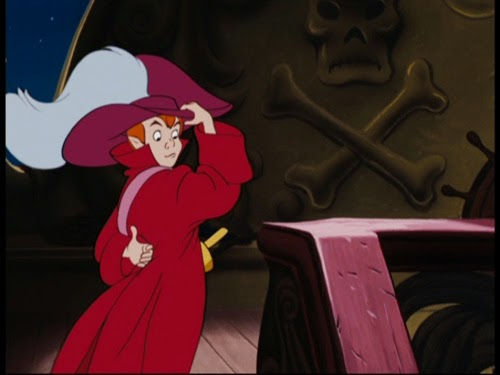
This difference in perspective is especially important in the relationship between Mr. Darling and Captain Hook. In visual representations of Peter & Wendy, the same actor often plays both characters, connecting Wendy’s father with Peter’s enemy. This does not mean that the two men are actually alike in every way; rather, Barrie uses Hook to represent how Peter understands adult men. Because Peter has deliberately refused to grow up, his understanding of adulthood remains stuck in a toddler’s perspective, where adults can seem like ridiculous tyrants who demand obedience without making sense. Hook is written to embody this stereotype because Peter has never willingly developed the more complex understanding of adults that comes with maturity. Wendy, meanwhile, is beginning to see her father as more than a foolish or stubborn authority figure. Through these contrasting perspectives, Barrie shows how a child’s stage of development shapes not only how they interpret the adults around them, but also the kinds of people they imagine those adults to be.
Peter’s refusal to grow up therefore affects more than his willingness to accept adult responsibilities; it also limits his ability to understand other people. Because he insists on remaining a child, he continues to view adulthood through a child’s simplified understanding of it. Wendy imitates her mother because she has observed the care and security her mother provides, even though she does not yet fully understand the role she is copying. Peter imitates the authority he associates with fathers without understanding the responsibility behind it. Barrie suggests that growing up requires not only learning how to act like an adult, but also learning to see beyond the childish stereotypes through which we first understand the world.
Ultimately, Peter’s greatest limitation is not that he cannot imitate adults, but that he cannot see them as anything more than the roles he has assigned them.


Comments